

Beta History
Beta Theta Pi has found a home on campuses across the United States and Canada since 1839. Among the oldest of all college fraternities, today Beta’s lifetime membership exceeds 215,000 men of principle. For generations, these brothers have made the Fraternity a leader in promoting brotherhood, personal growth and a sense of home for college-aged men.
The Founding
Beta Theta Pi, commonly known on campuses across North America simply as Beta, was founded on August 8, 1839, at Miami University in Oxford, Ohio. One of the oldest fraternities in existence, it was founded by students who had previously been members of the Erodelphian and Union Literary Societies but had greater aspirations for their own organization. Founder John Reily Knox, Miami 1839, noted at the time:
“There was an interest about the actions of men who bound themselves together by vows which were never broken and who pursued the great objects of their association with an energy that never tired, with a zeal which knew not-self, and with a devotedness that never counted gold.”
When Beta Theta Pi held its first meeting in the old college building known as “Old Main” (today’s Harrison Hall), eight founders were present to establish an order they believed would embrace the good of their fraternal peers without any of their objectionable features:
John Reily Knox, 1839
Samuel Taylor Marshall, 1840
David Linton, 1839
James George Smith, 1840
Charles Henry Hardin, 1841
John Holt Duncan, 1840
Michael Clarkson Ryan, 1839
Thomas Boston Gordon, 1840
“of ever honored memory“
That night, Beta Theta Pi – the oldest of the three fraternities forming the Miami Triad, along with Phi Delta Theta and Sigma Chi – was born.
In its nearly 185-year history, the many generations of men who have joined the Beta band have ascribed to the words of Founder Knox:
“What a few men united in object and effort will to do can be done; and more than that, such associations teach us in their records how far human friendships can carry us from the shrine of idol self.”
“Remember ‘tis virtue and wisdom that gave vitality to friendship”
1850 to 1900
Over the years, Beta Theta Pi became known for its entrepreneurial spirit, adopting the “Pioneering Fraternity” and “Leadership Fraternity” monikers. By 1850, Beta had already racked up several fraternal firsts, including being the first college fraternity founded west of the Allegheny Mountains (1839) and the first to host a General Convention (1848). During these formative years, many of the Fraternity’s signs and symbols began to take shape, including its first badge, coat of arms and the adoption of “delicate shades of pink and blue” as its colors.
The Civil War brought the Fraternity’s greatest early test. More than half of Beta’s 24 chapters were thrown into jeopardy, and hundreds of Betas fought on both sides, notably Founders Michael Clarkson Ryan served the Union while Founders John Holt Duncan and Thomas Boston Gordon served the Confederacy. Brotherhood outlasted the conflict: at Hanover College, Betas built a monument to a brother who died of illness in 1856, guarding it around the clock for a month when angry classmates tried to tear it down — and the boy’s grieving father was so moved by his son’s brothers’ devotion that he joined the Fraternity himself. When the war ended, chapters on both sides quietly welcomed each other back.
In 1879, Beta became the first fraternity to publish an Open Constitution for public distribution, stating its purpose “to promote the moral and social culture of its members” and “the establishment of confidence and friendly relations among the universities and colleges.” The move was controversial and many predicted it would tear the Fraternity apart, but it became the model the rest of the Greek world soon followed. Seven years earlier, in 1872, Beta launched The Beta Theta Pi magazine, still the oldest continuously published fraternity magazine in North America.
As the Fraternity continued to expand its vision for growth, its idea of a shared home also evolved. The first fraternity “house” of any kind is often recounted as being Beta’s own Zeta Chapter space at Hampden-Sydney College in 1850, and in 1885 Amherst built the first house owned outright by a Beta chapter, launching a tradition that continues today.
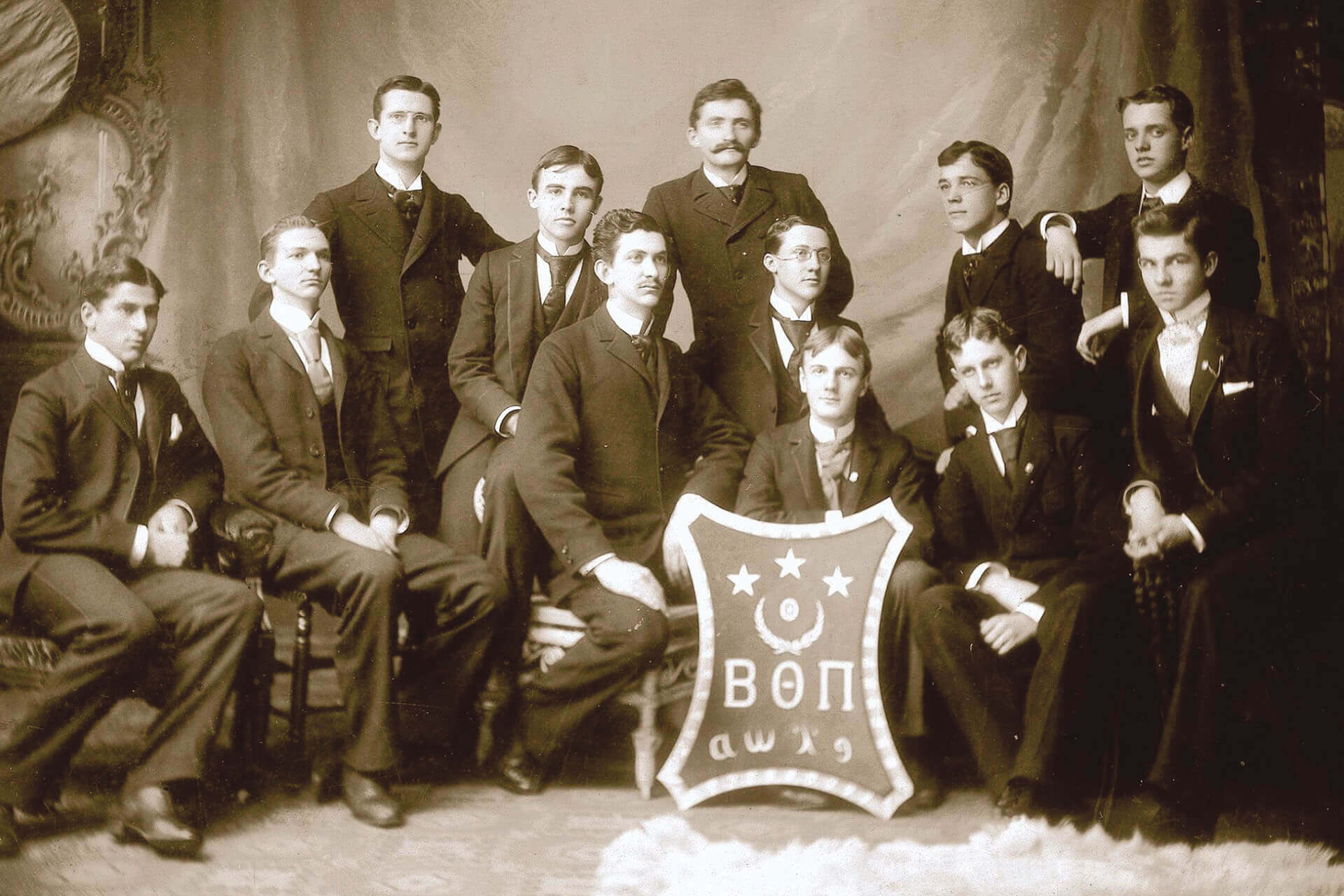
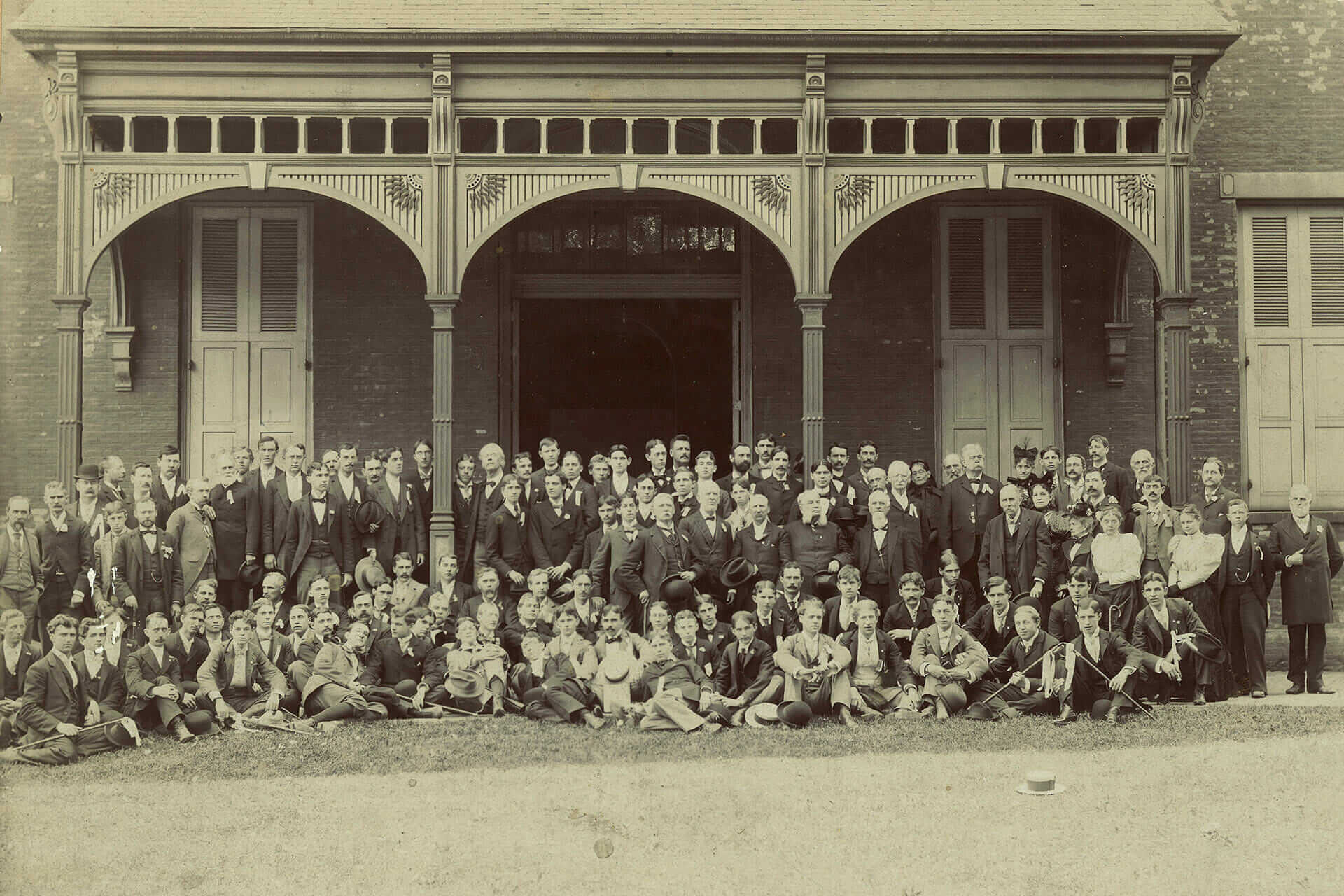
Heraldry & Archives
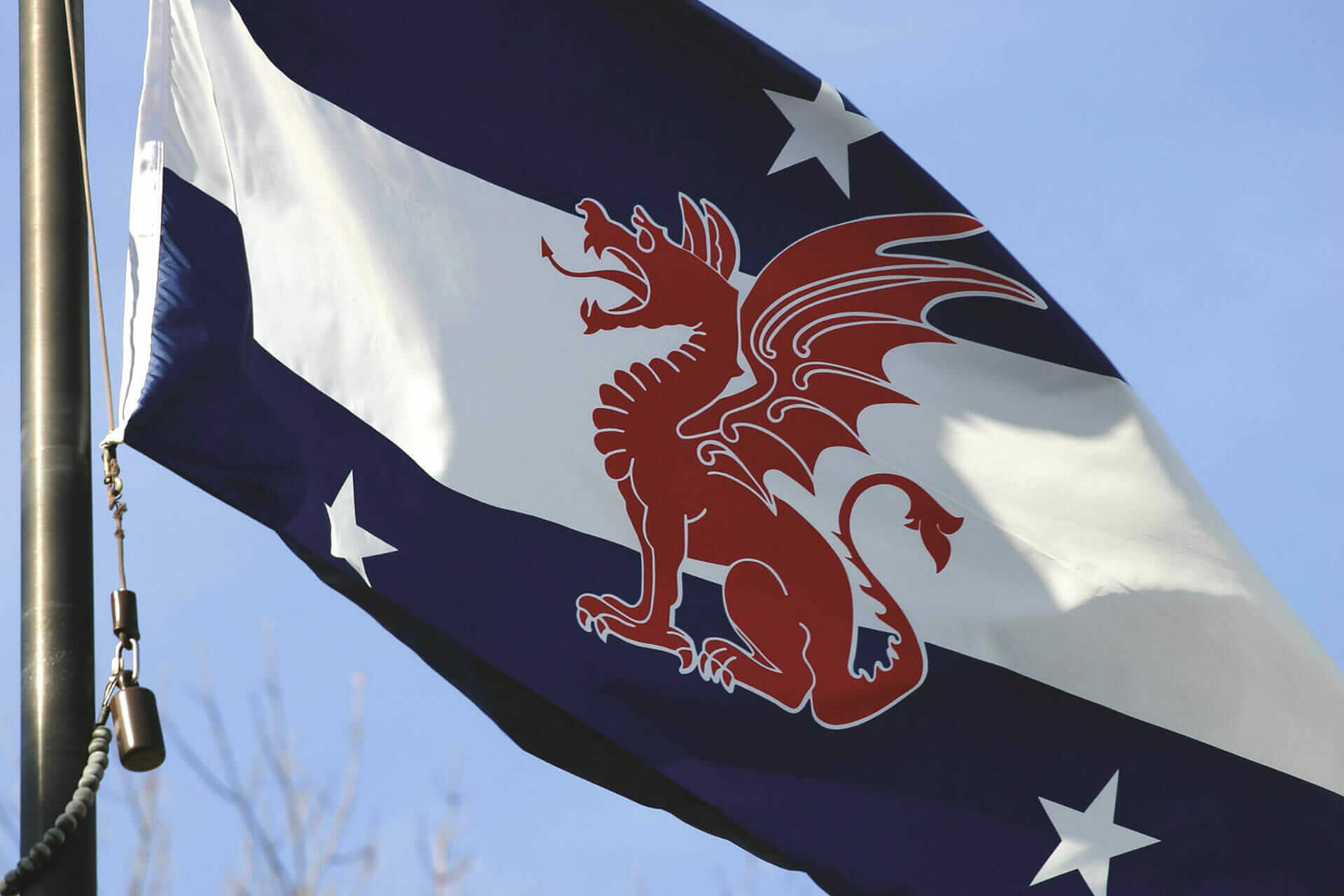
A more complete list of Beta’s signs and symbols can be found on the Heraldry and Archives page, including information on The Great Seal, Beta flag, Loving Cup and the “delicate shades” of pink and blue.
For an even deeper dive into the Fraternity’s past, search through more than 45,000 photos hand-scanned and organized by chapter in the Beta Archive. The gallery contains thousand of never-before-seen treasures, and will continue to advance in functionality over time.
1900 to 1950
This half-century is best defined by what brothers now call the “Beta Spirit,” described in 1905 by Willis O. Robb, Ohio Wesleyan 1879:
“The Beta is distinguishable and distinguished from all other kinds of fraternity men whatsoever, by just a little warmer and stronger, just a little tenderer and more enduring fraternity feeling than any of them can attain to … The first mark of a Beta will be his Beta spirit.”
The era gave brothers plenty to be proud of. In 1911, four sitting U.S. Supreme Court justices were Betas, by 1914 the Fraternity had cataloged more than 1,200 notable members in its book “Betas of Achievement,” and in 1919 the Founders Fund was established, which has evolved over time into the Beta Theta Pi Foundation and provided hundreds of millions of dollars in scholarships and leadership programming to members.
Two World Wars tested the Fraternity in gentler but still real ways. When Canada entered World War I in 1914, collegians of Beta’s Theta Zeta Chapter at Toronto enlisted early;13 of them (more than 10% of the chapter roll) gave their lives. Facing collapse without $2,500 to cover the mortgage on their chapter house, Theta Zeta appealed to the wider Fraternity, and brothers across North America responded, saving the chapter and giving rise to what’s remembered today as the Toronto Chapter Fund — a defining early example of Beta brothers supporting brothers.
The Fraternity triumphantly marked its 100th anniversary in August 1939, when more than 1,500 Betas gathered “‘neath the elms of Old Miami” for the Centennial Convention. As part of the celebration, the Fraternity built the Beta Campanile as its gift to Miami University. Dedicated in 1941, it still stands today as the physical landmark most associated with Beta on its home campus.
World War II soon followed, and three Betas earned the Medal of Honor for their service. The Fraternity made a point of not suspending any chapter for the duration of the war, even when membership dropped to almost nothing. When peace returned, veterans flooded back to campus and 1946-47 saw a record number of new initiates. That growth made clear the Fraternity needed real infrastructure to support it. In 1949, Beta opened its first Administrative Office in Oxford, Ohio, marking the shift from an all-volunteer operation to a professionally run organization.
See and hear more about many of these notable moments and markers in Beta’s history in the interactive Heritage Tour below.
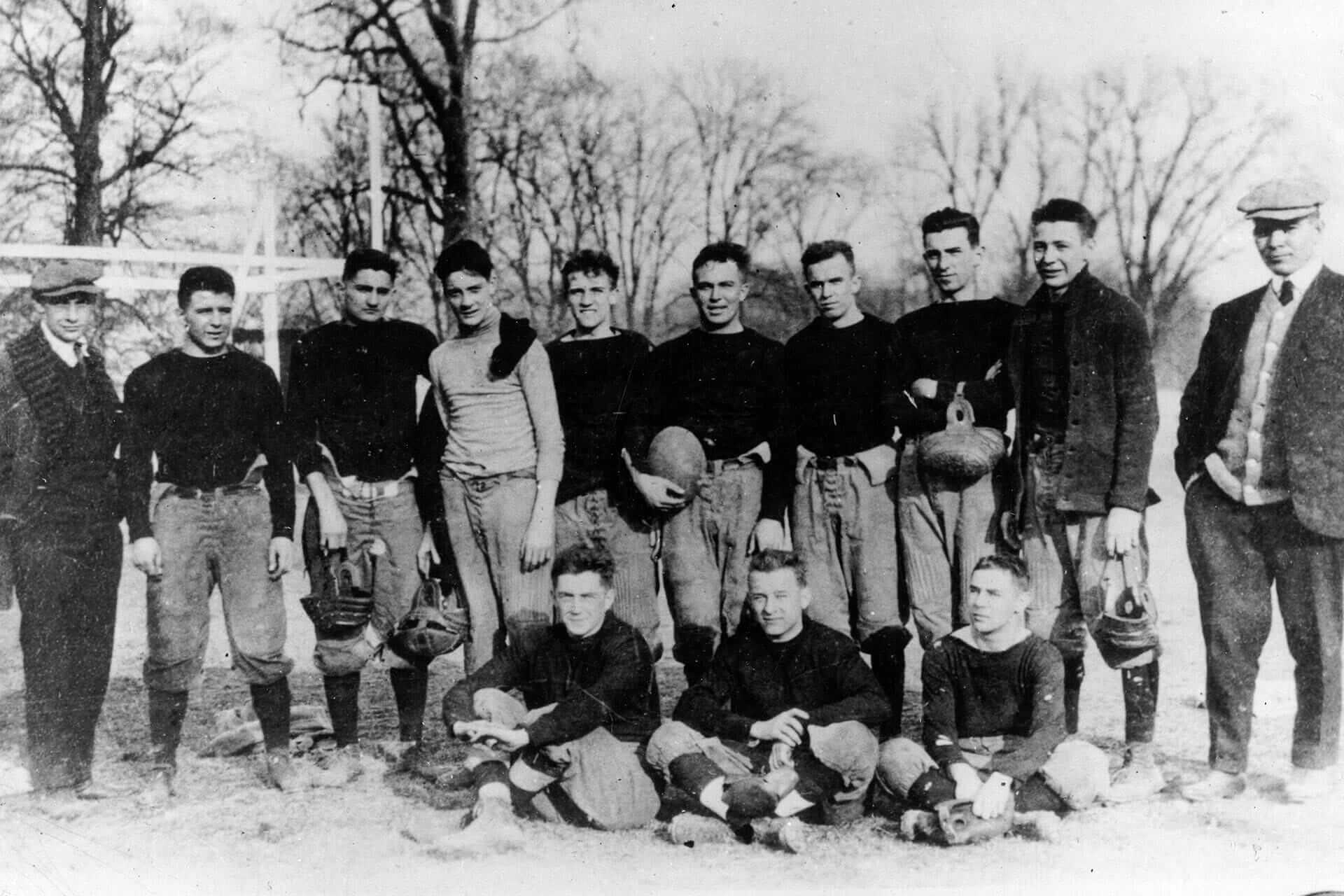
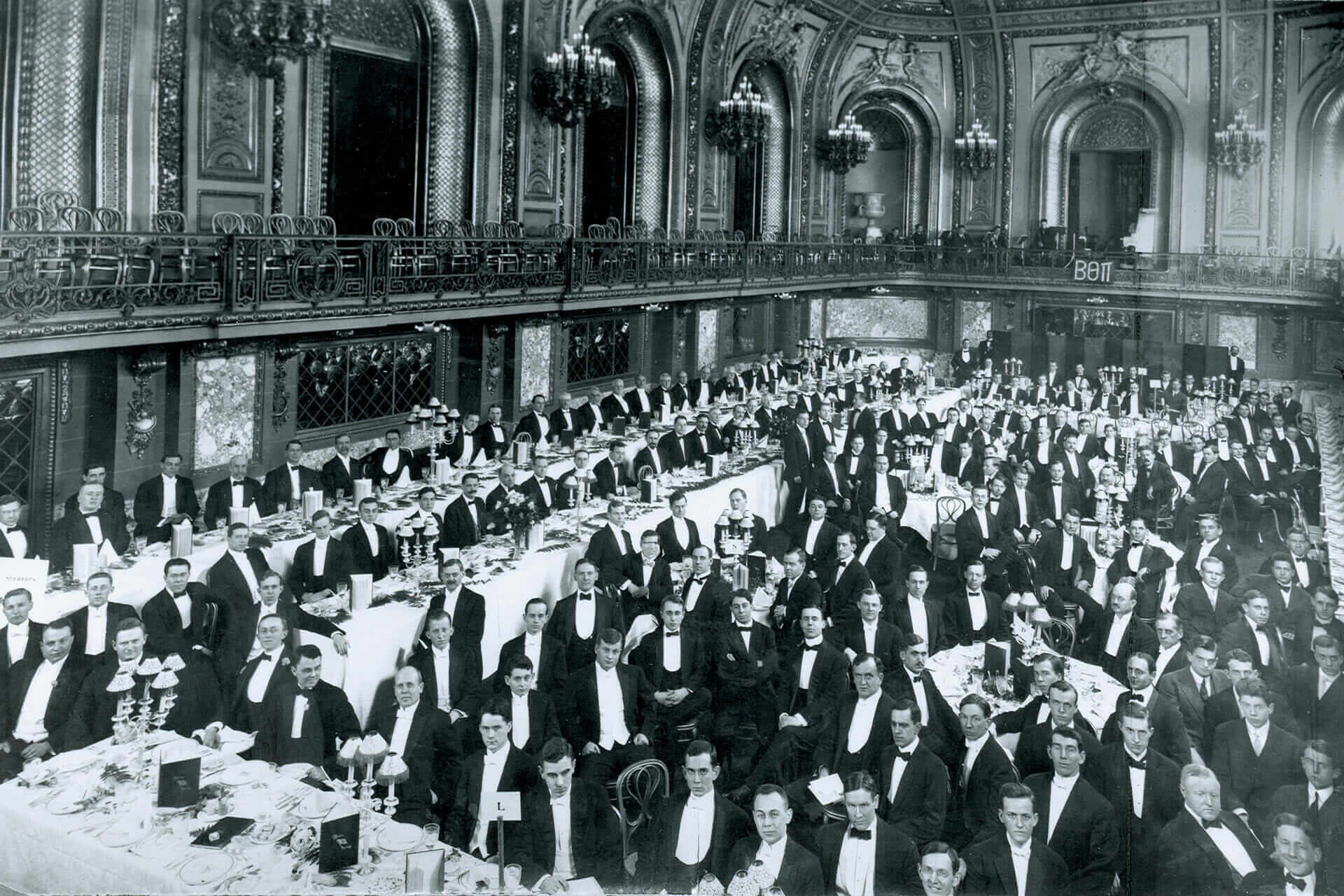
“Thus honor shall come to the badge that we wear and every Beta that honor shall share.”
1950 to 2000
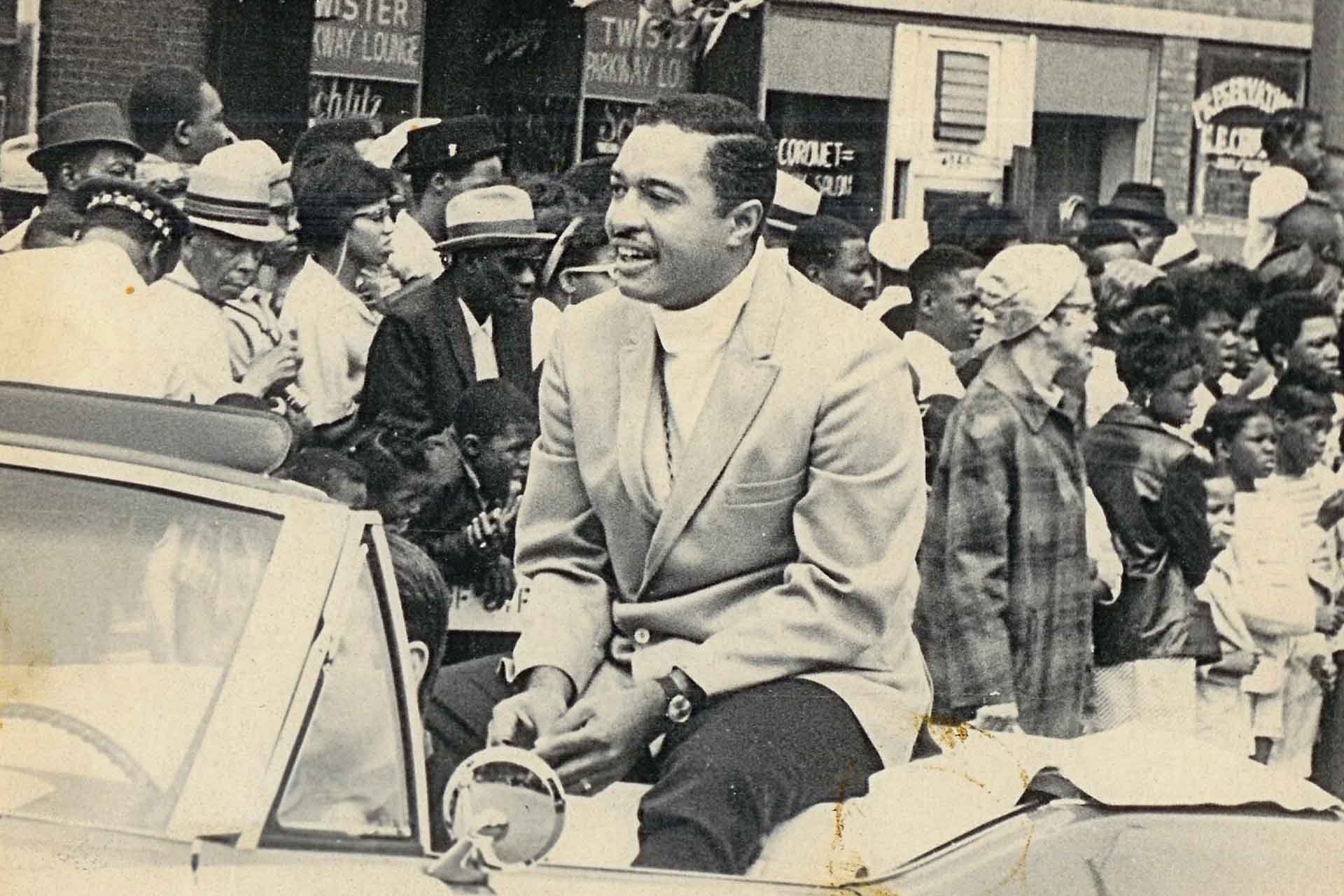
The postwar decades brought new tests, including the Korean War and campus unrest of the Vietnam era, but Beta’s growth continued. In 1954, just weeks ahead of the U.S. Supreme Court’s landmark ruling in Brown v. Board of Education, Bill Lowry, Kenyon ’56, became the Fraternity’s first African American member.
“In the years that have passed since that time, I don’t think I’ve experienced another act of personal involvement displaying the courage and equity [my chapter brothers] displayed at that time,” Lowry recalled. “From that moment on, I was sold on the type of men that Beta Theta Pi produced.”
Beta doubled down on developing its members during these years. The Beta Leadership Fund, launched in 1971, began what’s now more than 50 years of funding leadership programming for collegians and volunteers. In 1984, Beta became the first fraternity in the country to adopt a minimum GPA standard for its chapters (2.50) — a move some fraternity leaders predicted would fail, but one the rest of the Greek world eventually followed.
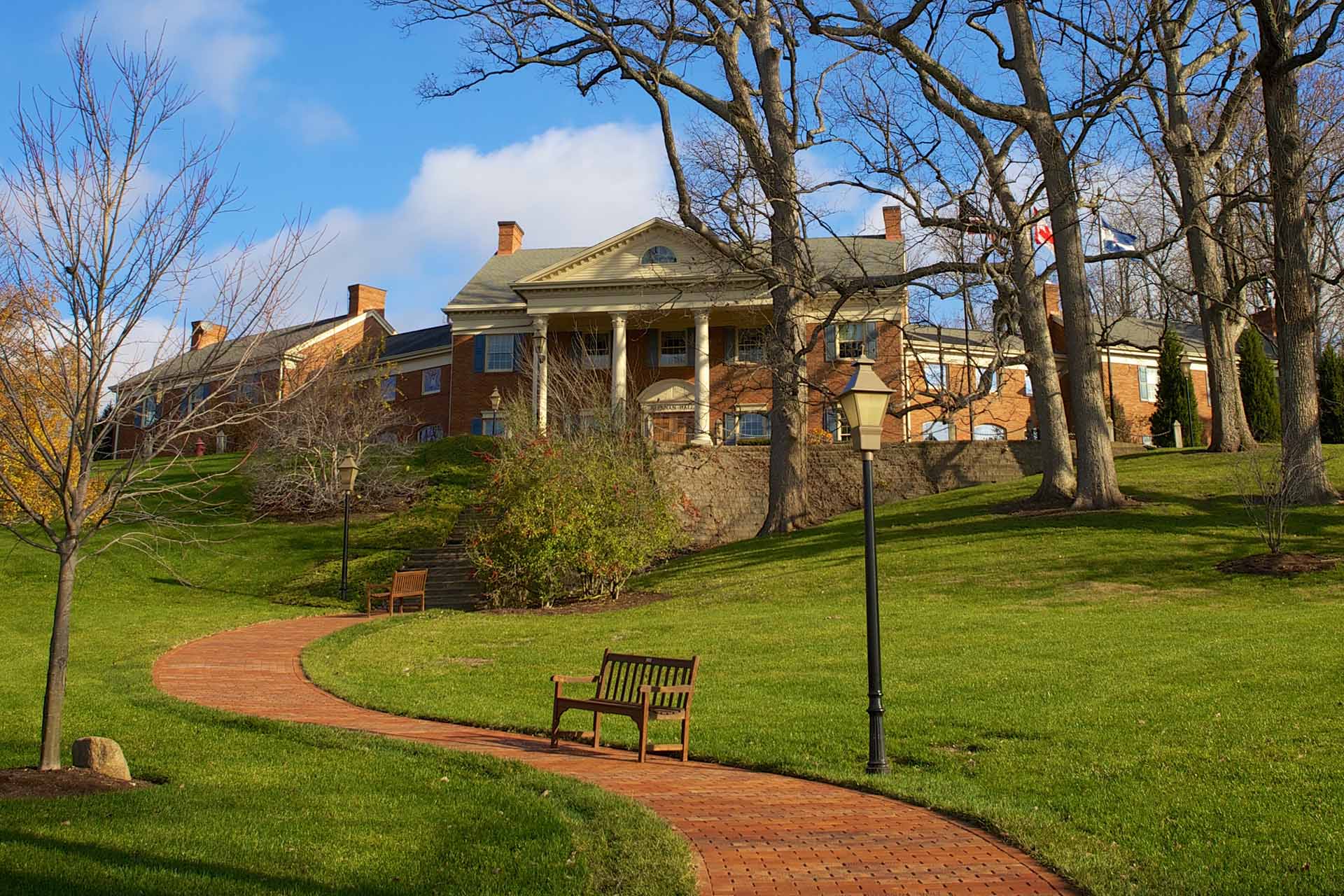
As the Fraternity grew, so did its need for a real headquarters. In 1994, Beta dedicated its current Foundation and Administrative Office in Oxford, Ohio, which is an eight-acre campus funded almost entirely by alumni gifts and built around a Hall of Chapters modeled on the original 1839 meeting room.
Like much of the fraternity world, Beta wasn’t immune to the “Animal House” culture that took hold on many campuses in these decades, and for a time the longevity of the Fraternity’s core traditions was genuinely in doubt. That reckoning came to a head in 1998, when Beta’s founding Alpha Chapter was closed over risk management concerns. Its reestablishment the following year became a turning point, setting the stage for the sweeping reforms of the next chapter in Beta’s history.
2000 to Present
Realizing a recommitment to Beta’s founding values was necessary, the Fraternity launched the award-winning Men of Principle initiative in 1998 with U.S. Senator Richard Lugar, Denison ’54, as its national spokesman.
The initiative’s impact showed up in the numbers. Beta’s chapter GPA standard climbed steadily — from 2.50 in 1997 to 2.70 in 2006 to 2.80 (or the campus all-men’s average, whichever is higher) in 2012 — making Beta a repeat leader among all North American fraternities in scholarship. The Fraternity continues to set new records in academic achievement even today, routinely topping a 3.30 all-chapter GPA.
Beta’s investment in Men of Principle was backed by real philanthropic muscle: the Foundation’s “Upon These Principles” campaign raised more than $20 million by 2006, at the time the largest capital campaign in Greek-letter history, followed by the “Promises to Keep” campaign in 2016.
The Fraternity marked major milestones along the way — a record-setting 175th Anniversary Convention in 2014, the initiation of its 200,000th member in 2015, more than 1,000 students receiving leadership training annually and collegiate membership surpassing 10,000 for the first time in 2016 (and approaching 11,000 in recent years). Today, as it was back in 1839, Beta Theta Pi continues to be a leader across North America for what’s possible when men come together in a brotherhood of purpose, friendship and fidelity.

“There’s a scene where brothers greet, where true kindred hearts do meet…”
The Singing Fraternity
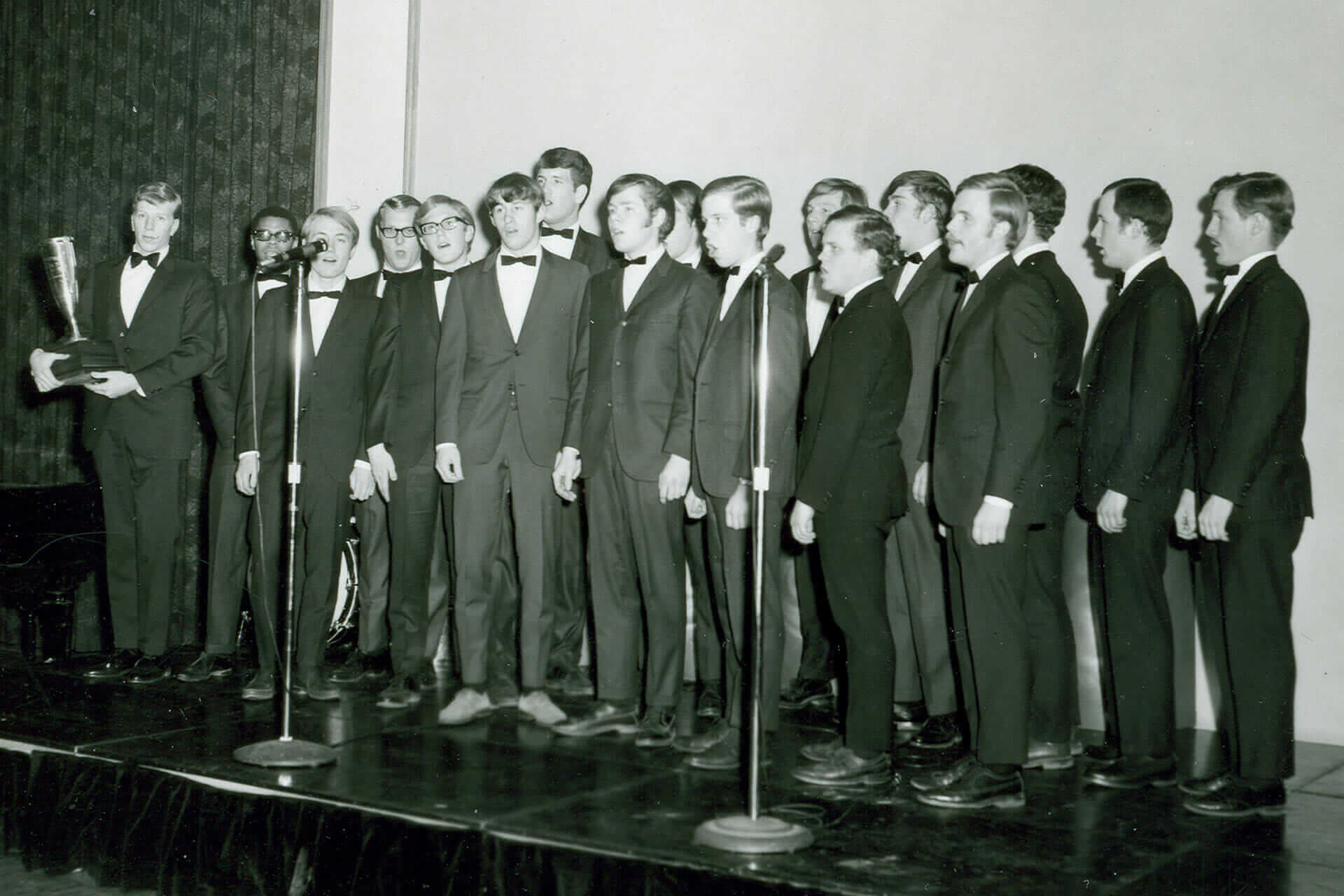
Even before the first decade of the Fraternity’s history ended, Betas raised their voices in a collection of songs. These were printed on a card and included opening and closing odes, a benediction, an initiation song, and a greeting of new members.
So essential was singing in the Fraternity’s founding and growth during the 19th century that many songs and poems emerged from that era, many of them still popular.
Collections of Beta songs appeared periodically until 1902 when the publication became a red hard-cover book with gold leaf imprinted cover — a format that was followed for the next 90 years.
The Fraternity’s song collection has grown to be quite extensive over the years, containing songs written to long-familiar music and a number also set to original tunes. Additions are made from year to year, each new edition of the songbook containing new melodies.
Heritage Tour
Oxford has so much to offer when it comes to fraternity history, let alone Beta Theta Pi’s. Home of the Miami Triad — Beta Theta Pi, Phi Delta Theta and Sigma Chi — and the Alpha chapters of the Delta Zeta and Phi Kappa Tau, Miami is affectionately known as the Mother of Fraternities. Take a stroll through time and explore the many heritage sites Oxford has to offer.
From the Beta Campanile to the Alpha Chapter house, this exclusive audio tour will be your guide every step of the way as you reminisce every moment that shaped the Great and Good Fraternity. Or, explore Oxford’s heritage sites virtually. The tour is designed to begin at any of Beta’s heritage sites in and around Oxford. Use the map to guide you to the next stop of your tour.
Alpha Chapter House
The Alpha Chapter House
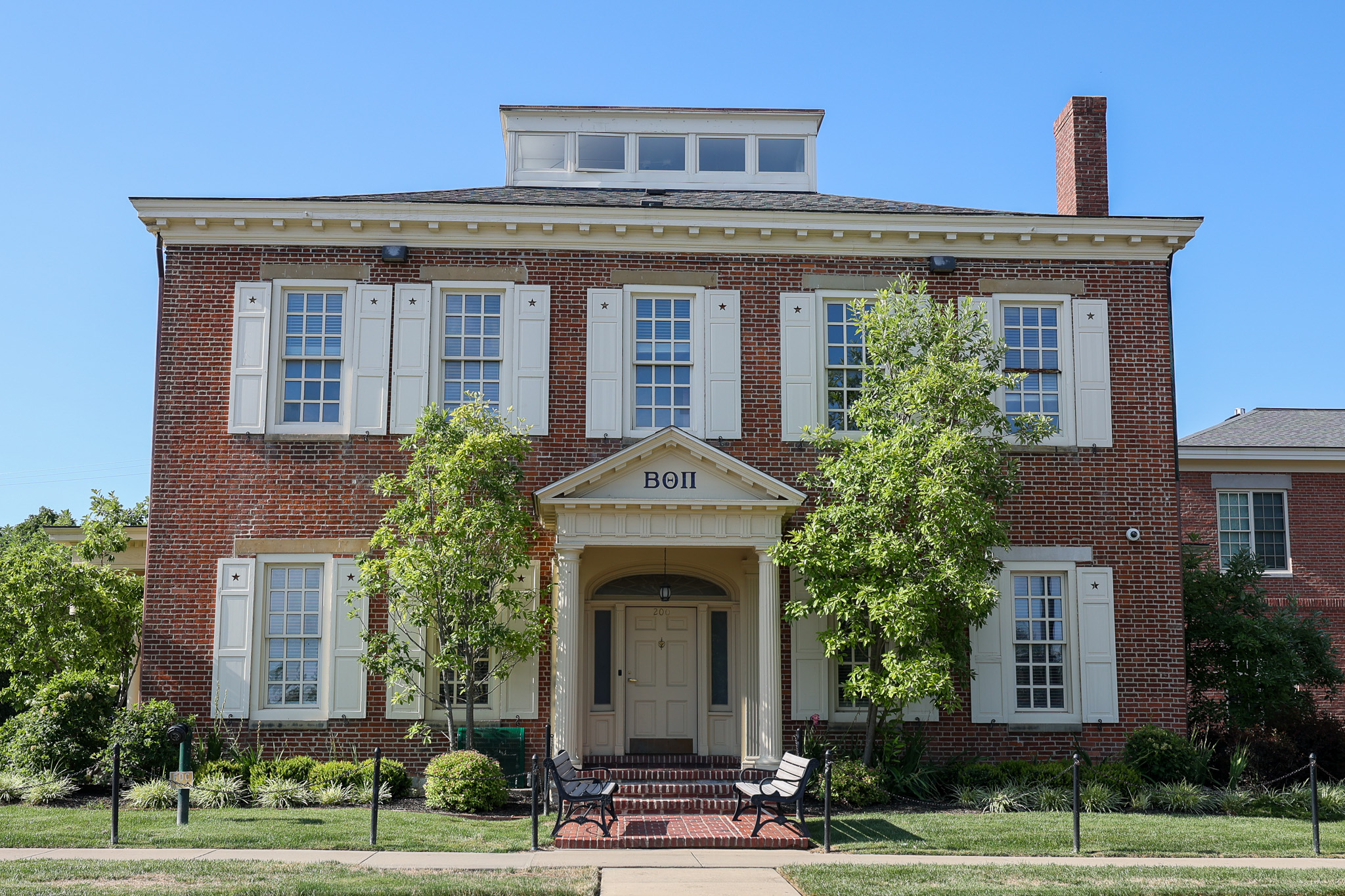
Many renovations have happened through the years and countless notable Miami men have walked through the front door. Start at the front of the house and join General Fraternity Historian and Archivist Zac Haines, Miami ’05, for a brief history on how the Alpha Chapter found their home at 200 East High Street in Oxford.
Inside the Chapter Home
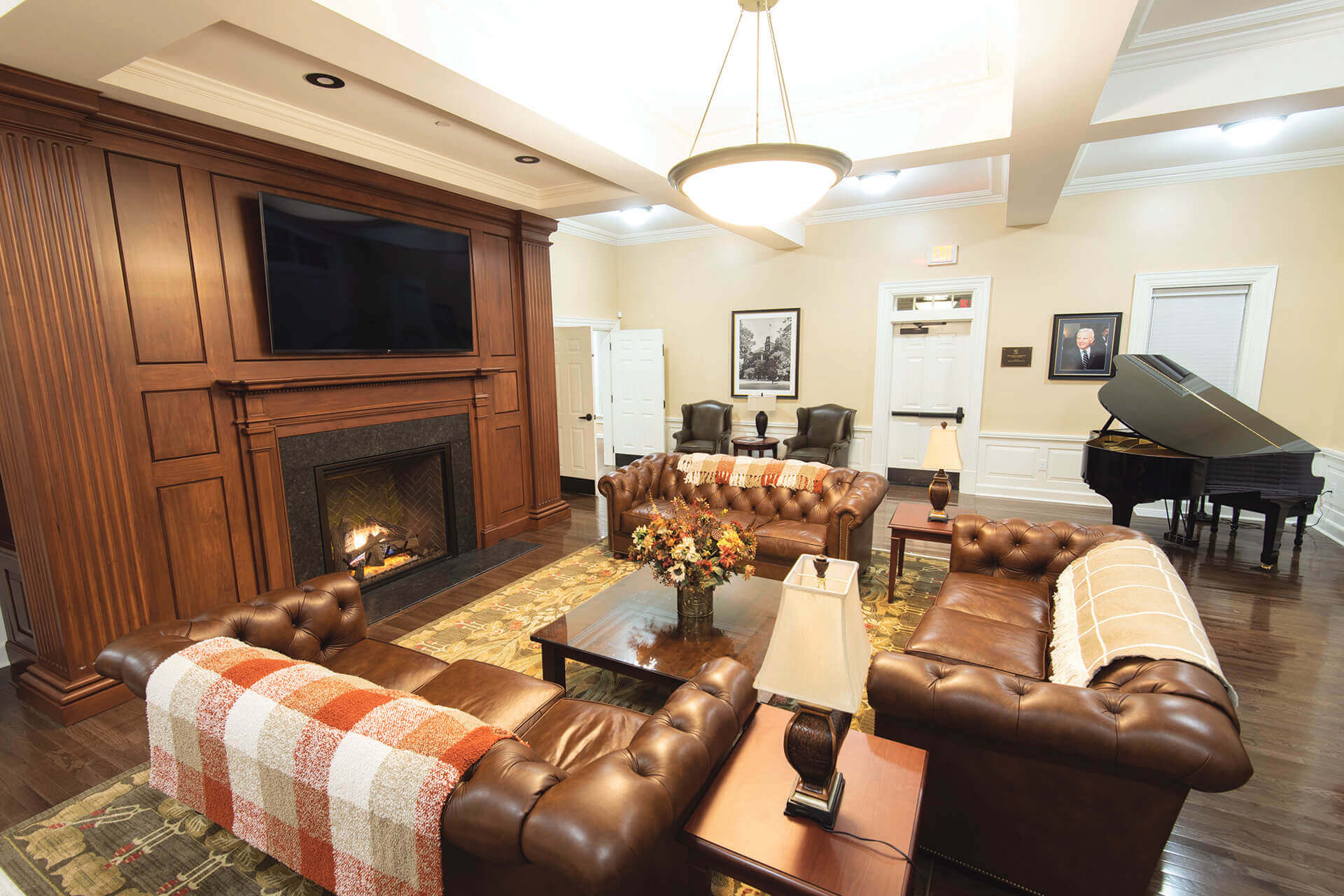
If you are able to enter the chapter house, explore the balance of modern and traditional amenities. See how each renovation worked toward making it a unified chapter home.
Alpha Chapter Museum
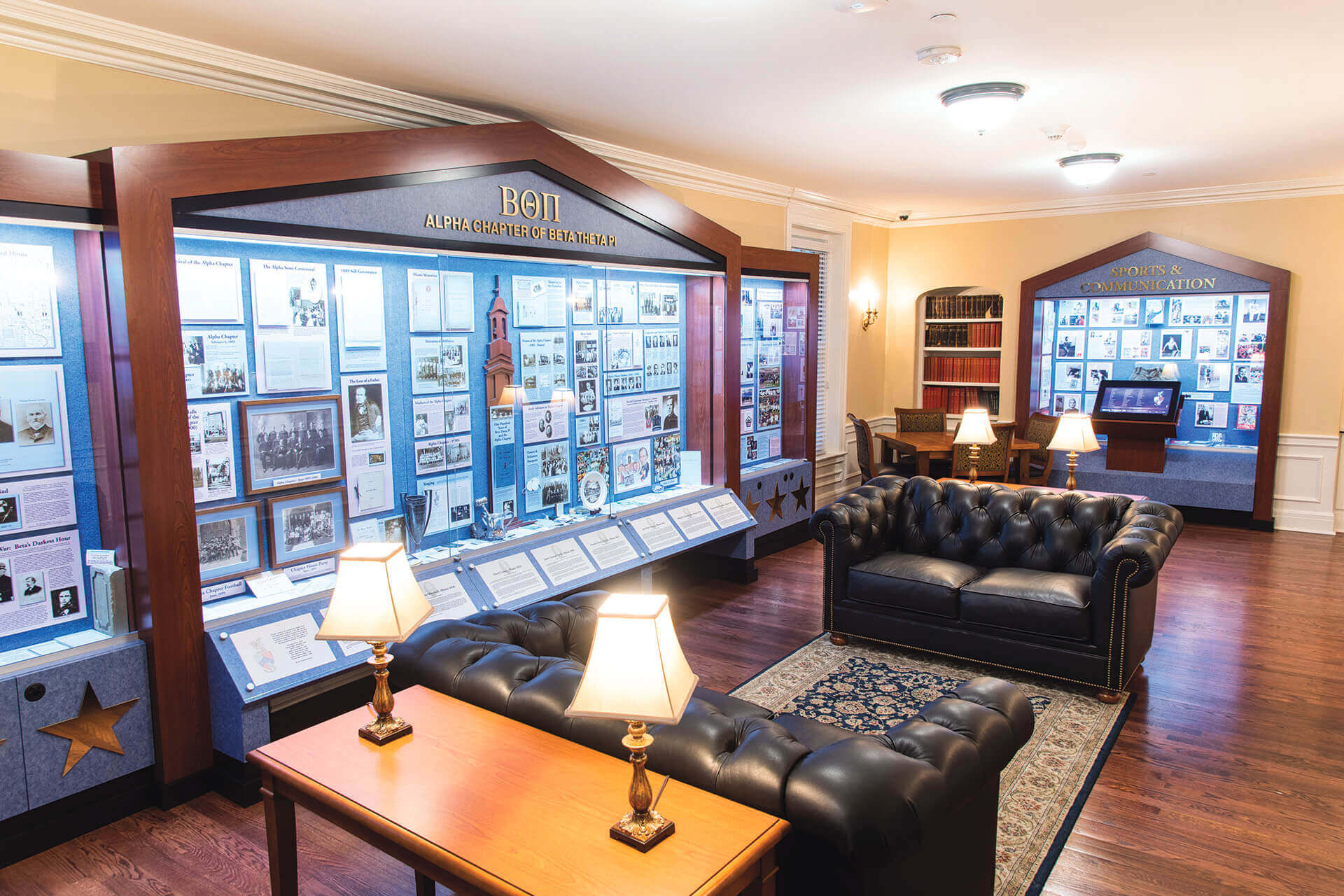
Tour guide and General Fraternity Historian and Archivist Zac Haines, Miami ’05, completed countless hours of research to provide for the Alpha Chapter Museum on the first floor of the house as a gift to the chapter in 2007. Notable exhibits include a scan of the original constitution and a time capsule recovered during the 2018 renovation, in addition to exploring themes through the chapter’s storied history.
The Beta Quadrangle
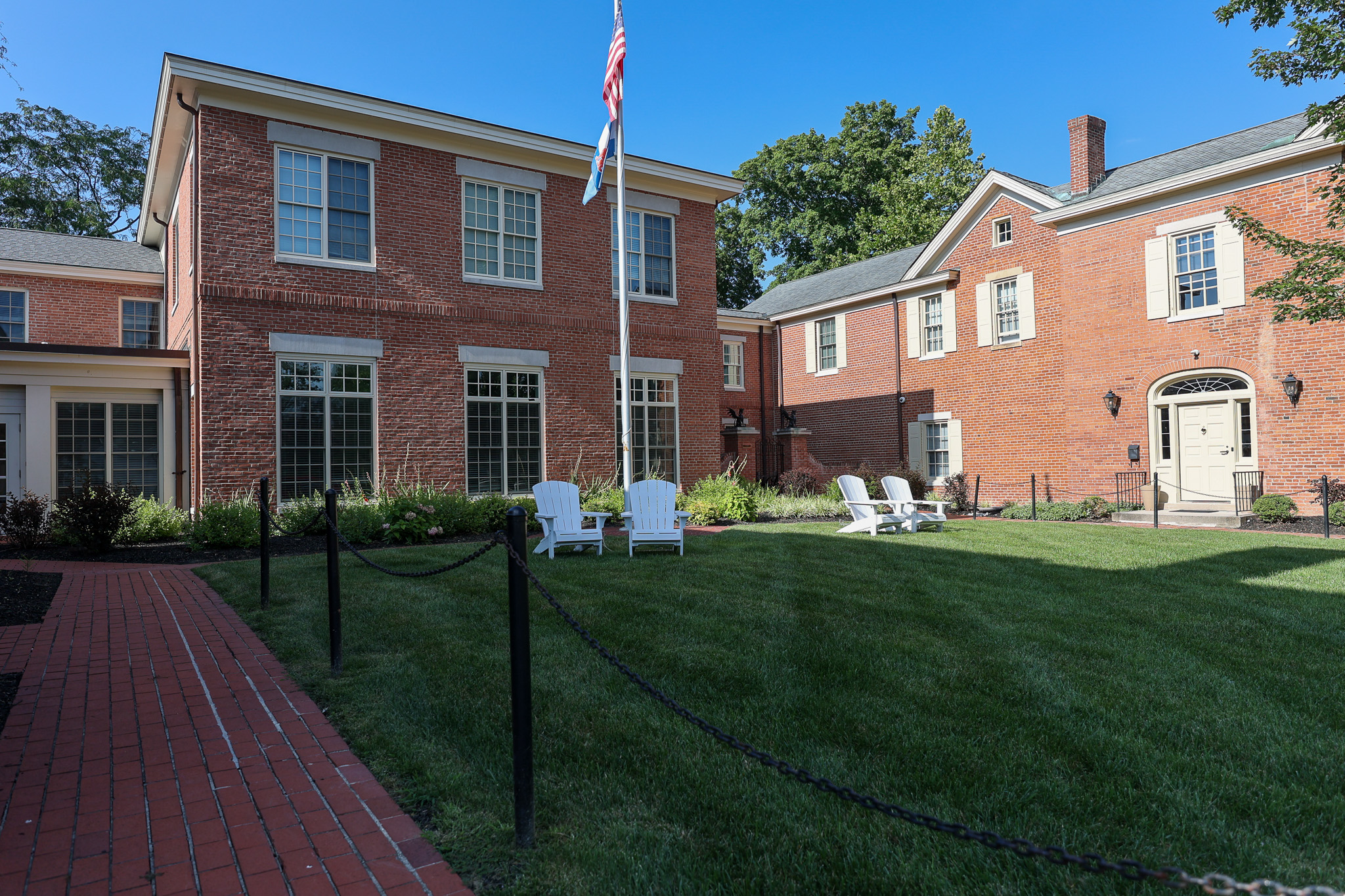
Outside, green space like this is not common at many chapter houses, and it almost wasn’t meant to be. The Beta Quadrangle offers a perfect spot for Miami men to relax between their studies.
Beta's First Administrative Office
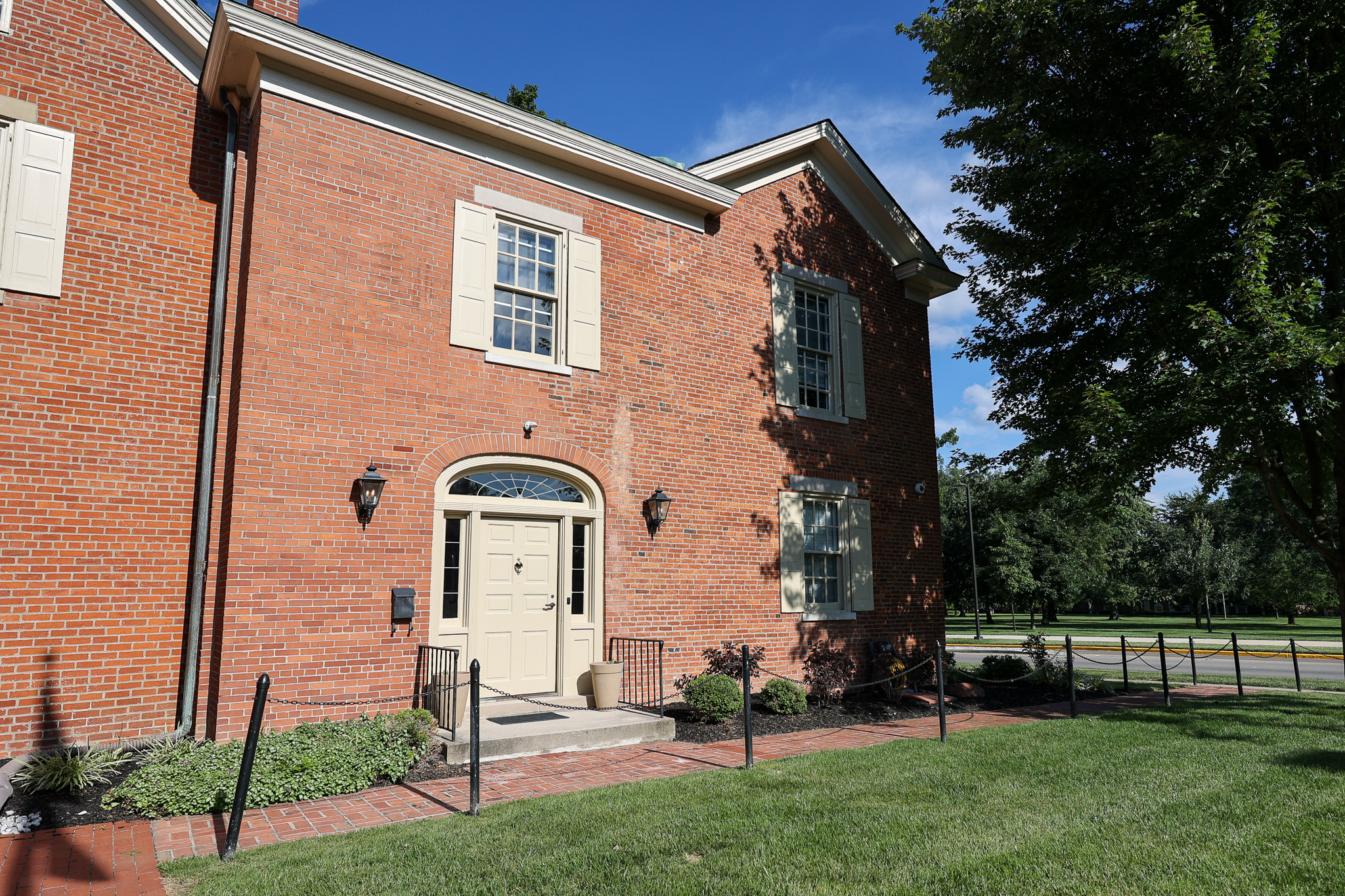
In addition to the lot next door being Alpha Chapter’s first house, the right-side building was the Fraternity’s first Administrative Office. After the office moved about a half-mile north of town, the chapter merged the two buildings together to expand their home.
Harrison Hall
Old Main
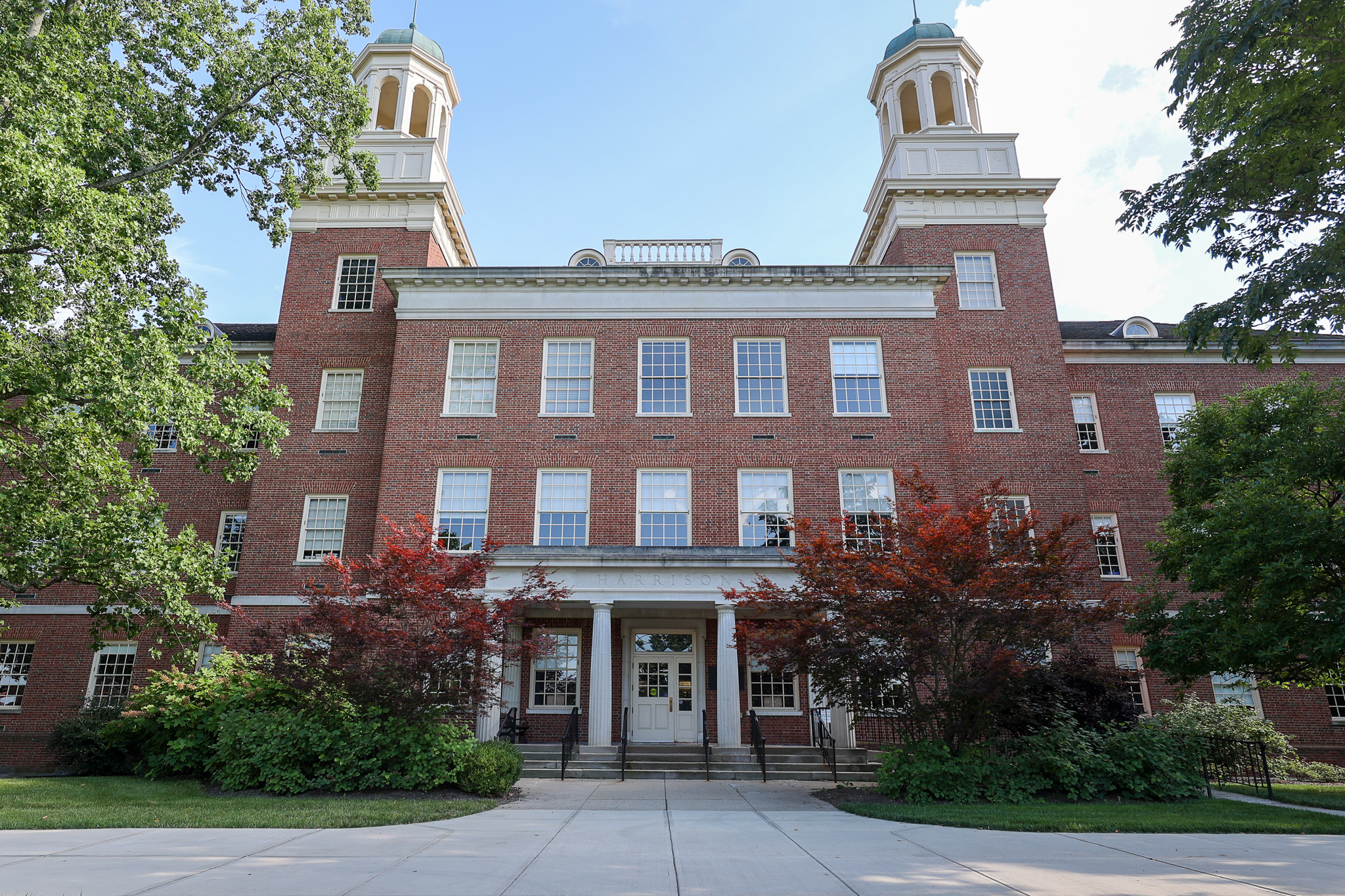
Go back in time with Chief Operating Officer John Reineke, Central Michigan ’09, to the earliest days of Miami University and imagine the lone classroom building on campus, the birthplace of Beta Theta Pi.
The Founding
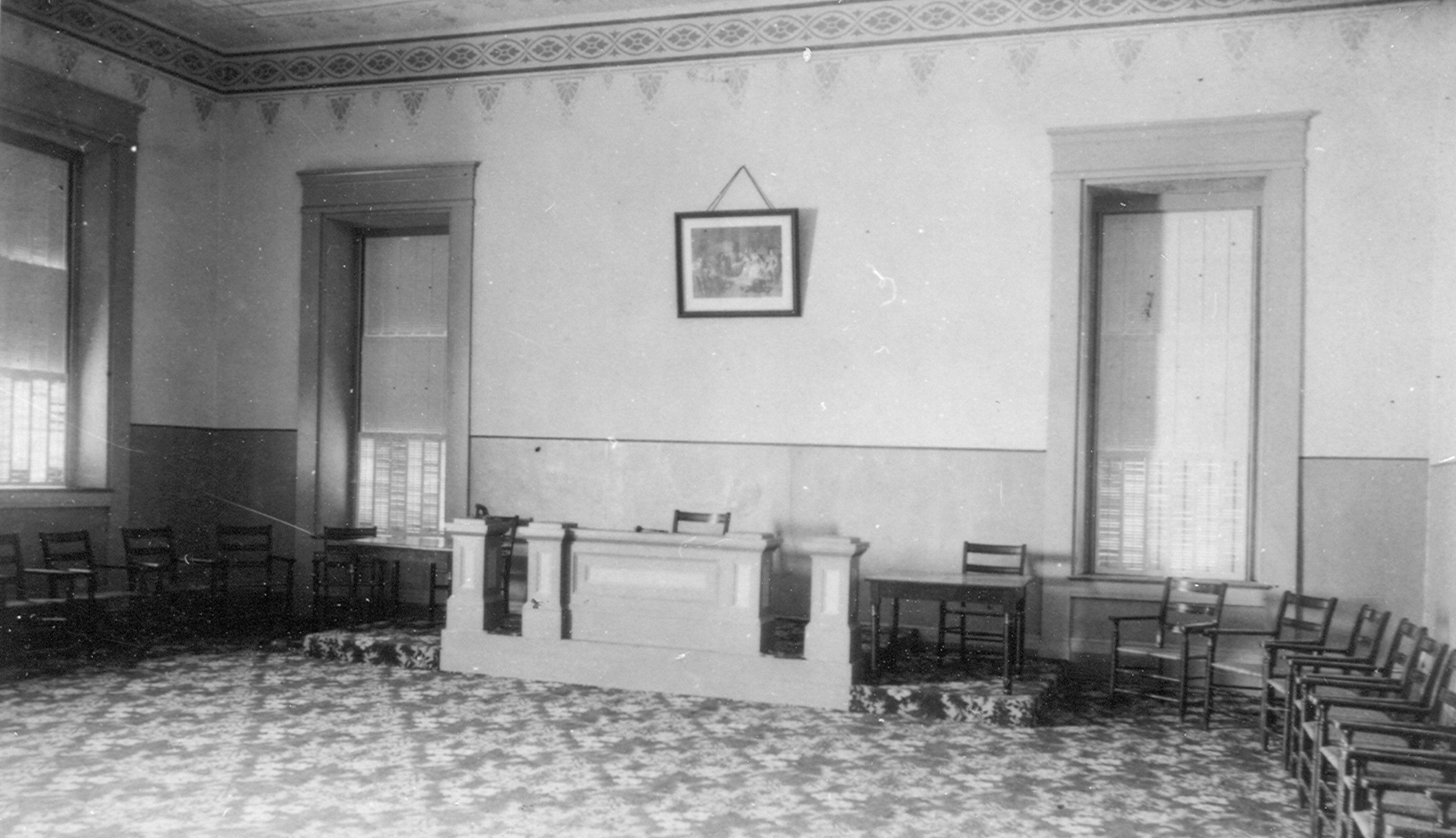
If you are able to, head inside Harrison Hall and up to the third floor – room 304 to be exact. Here, on August 8, 1839, Beta Theta Pi was founded.
The Halls of the Literary Societies
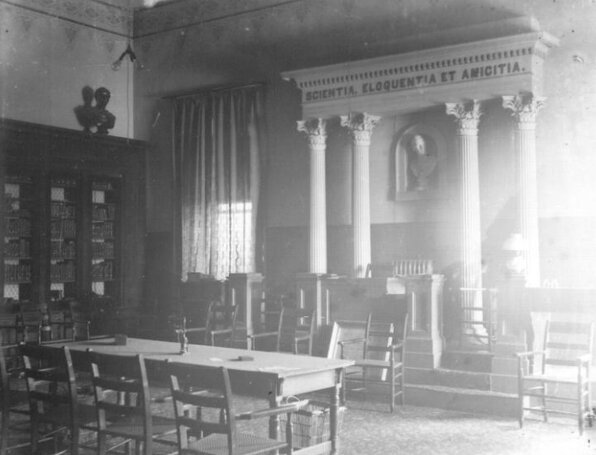
Stay on the third floor for this second-part of this stop on the audio tour, exploring more on the impact of the two prominent literary societies on campus.
John Reily Knox and His Associates
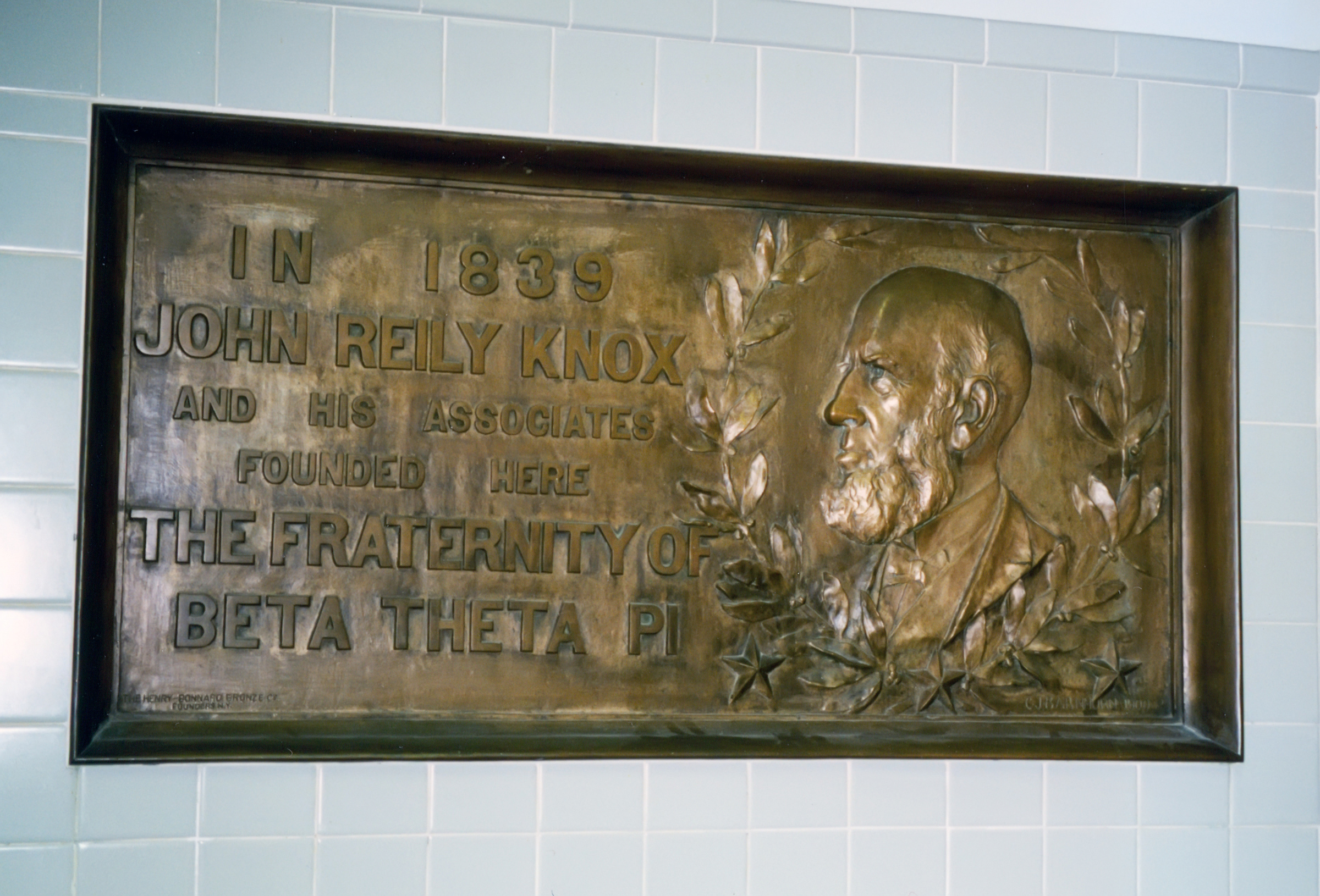
Affixed on the wall near the rear entryway of Harrison Hall is a bronze tablet older than the Beta Campanile. Upon the death of John Reily Knox, this tablet was presented to celebrate the founding of the Fraternity.
Early Days of Old Miami
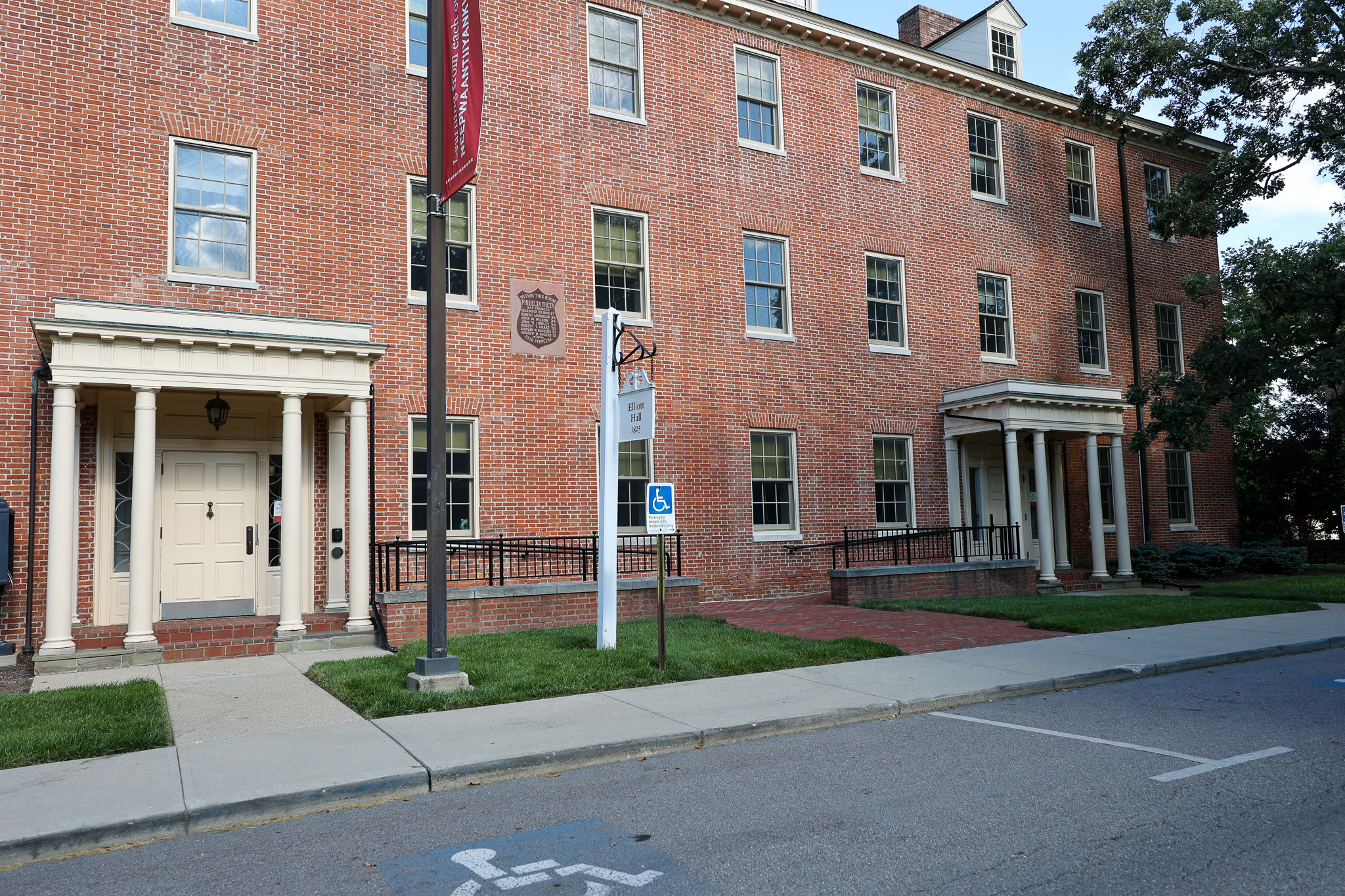
Between Harrison Hall and the Campanile are two of the original dorms on campus. As this section of the tour comes to a close, learn what college life was like in the 1800s.
Beta Campanile
The Campanile
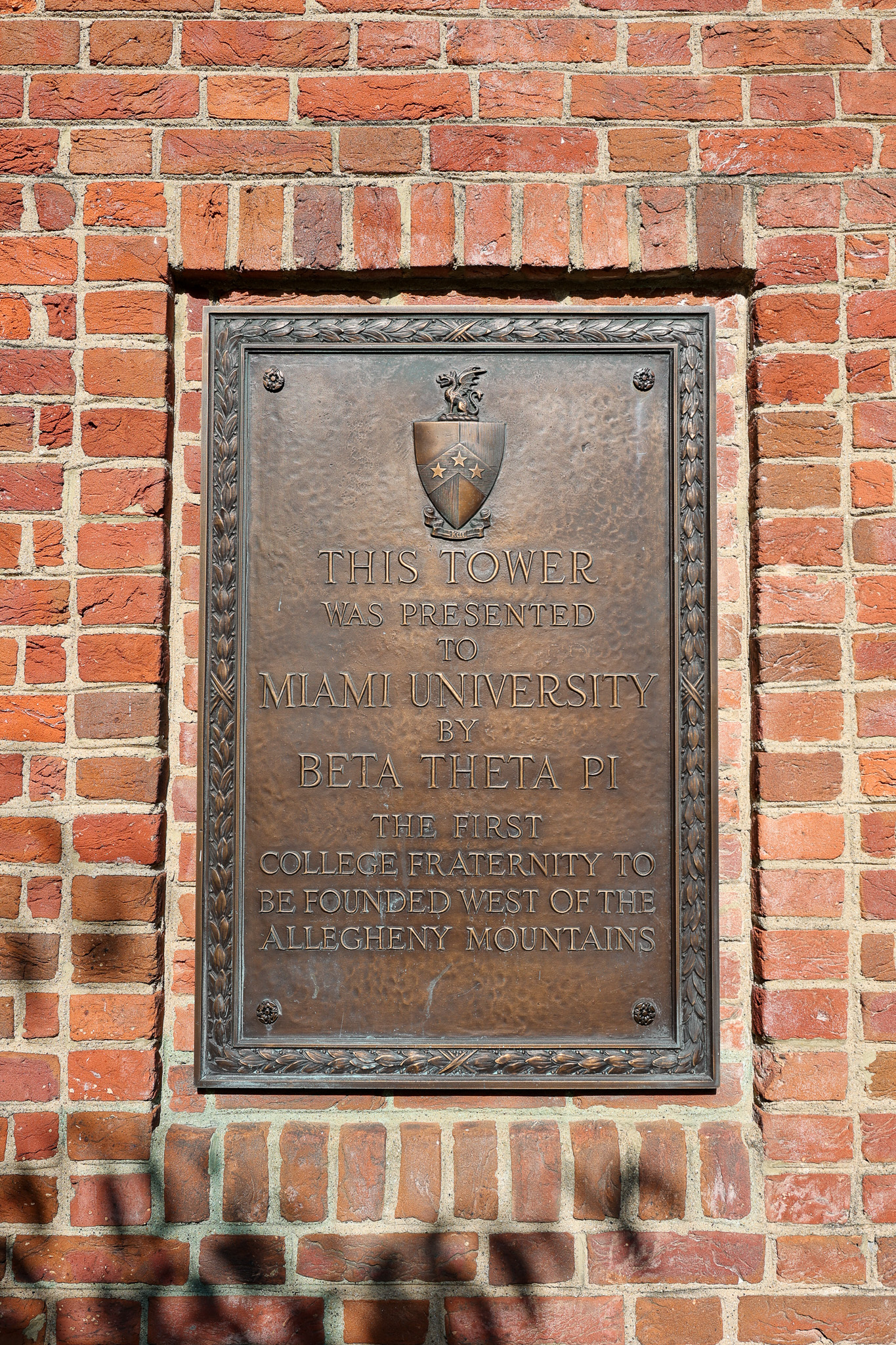
Chief Foundation Officer Phil Fernandez, Miami ’06, guides you through the storied history of the Beta Campanile (pronounced “kam-puh-nee-lee). Start here at the memorial plaque facing Bell Tower Commons and work your way around the Campanile clockwise to explore milestones backward run.
The Sesquicentenary
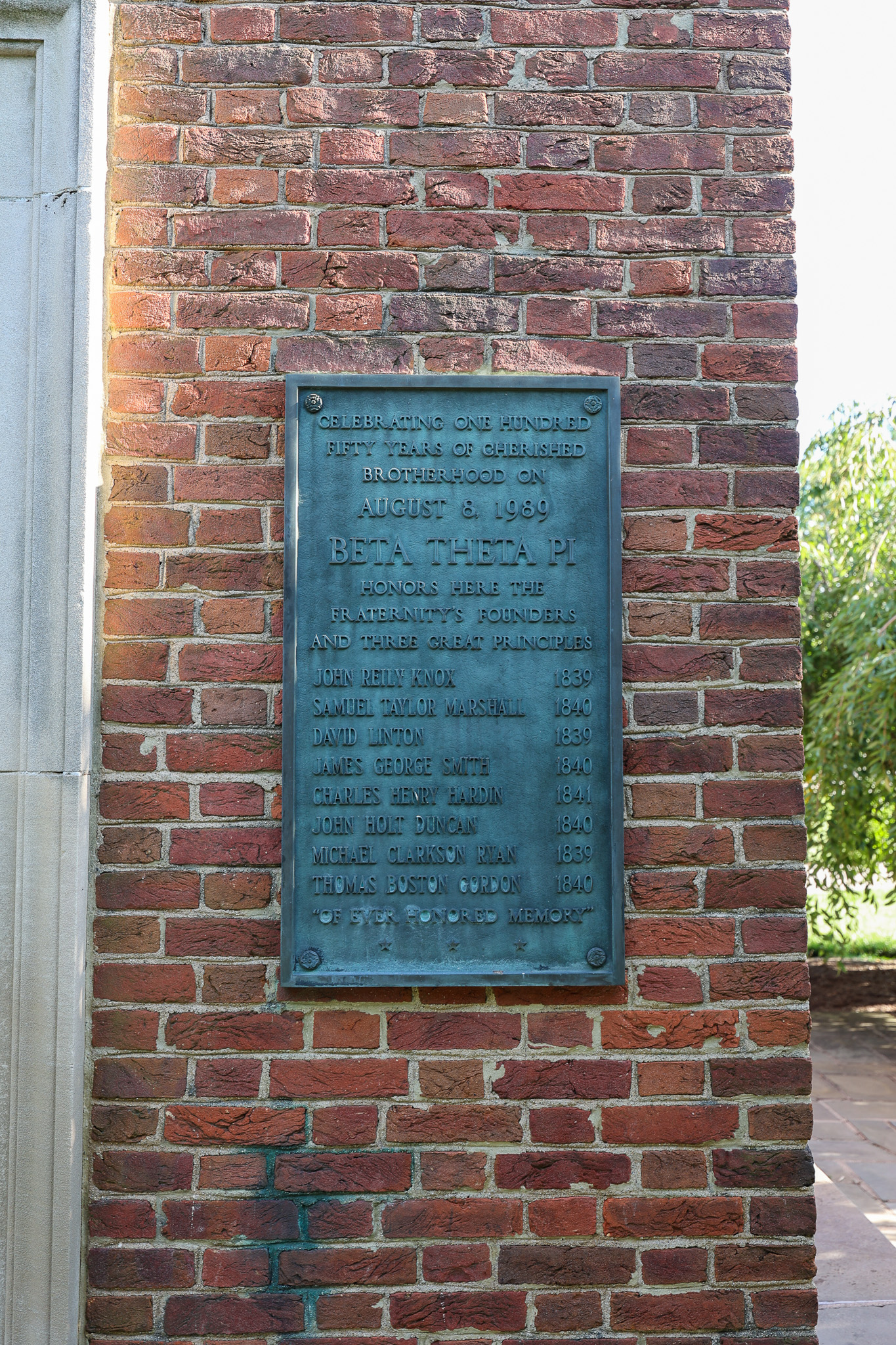
Beta celebrated its 150th anniversary in 1979 with the presentation of a fourth plaque on the Campanile, honoring the founders.
Beta's 175th Anniversary
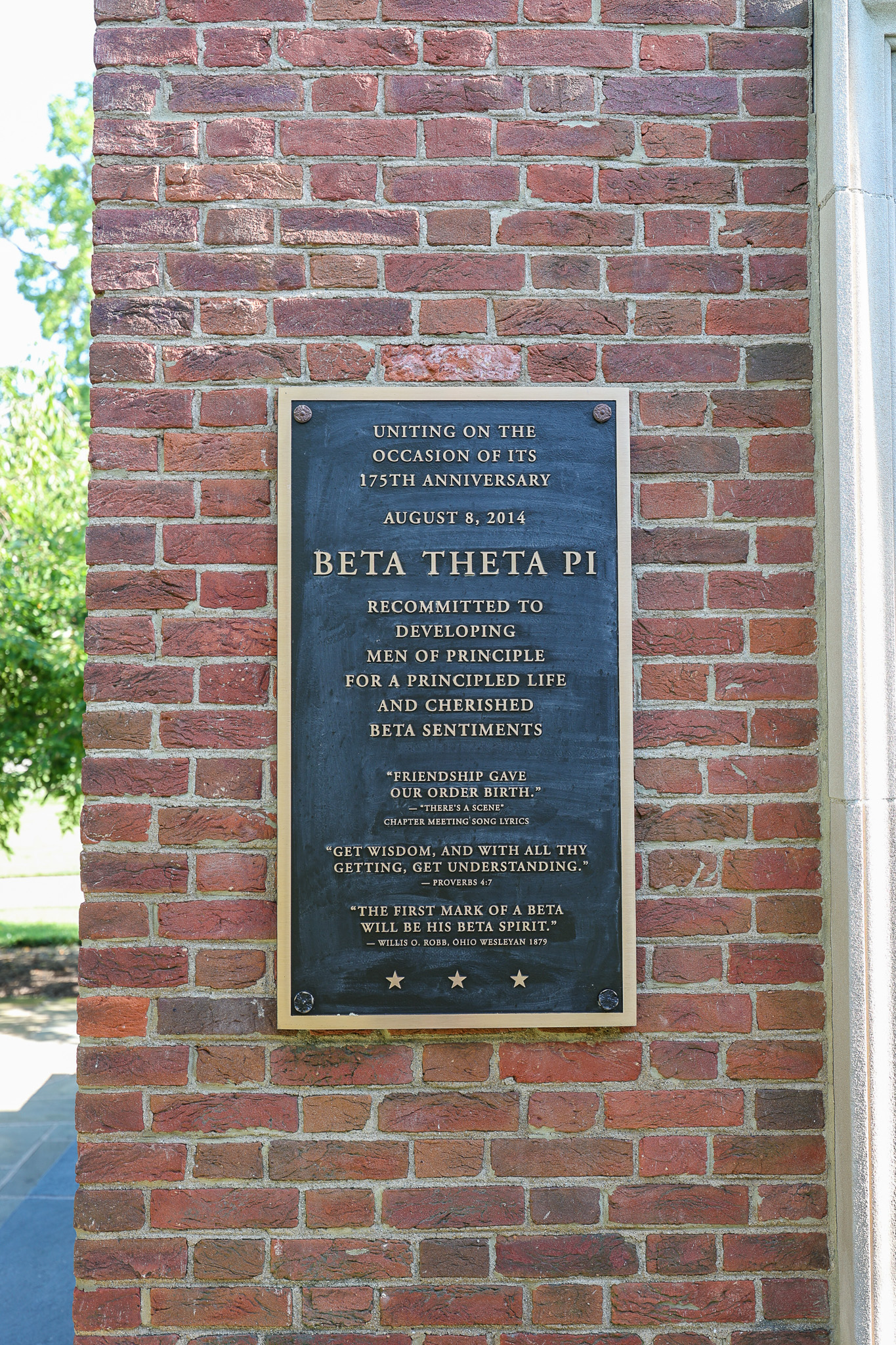
The most recent milestone was the dodransbicentennial celebration in 2014, hosting more than 1,500 brothers, Sweethearts and Friends of Beta in Oxford.
The Beta Bells and Centenary Day
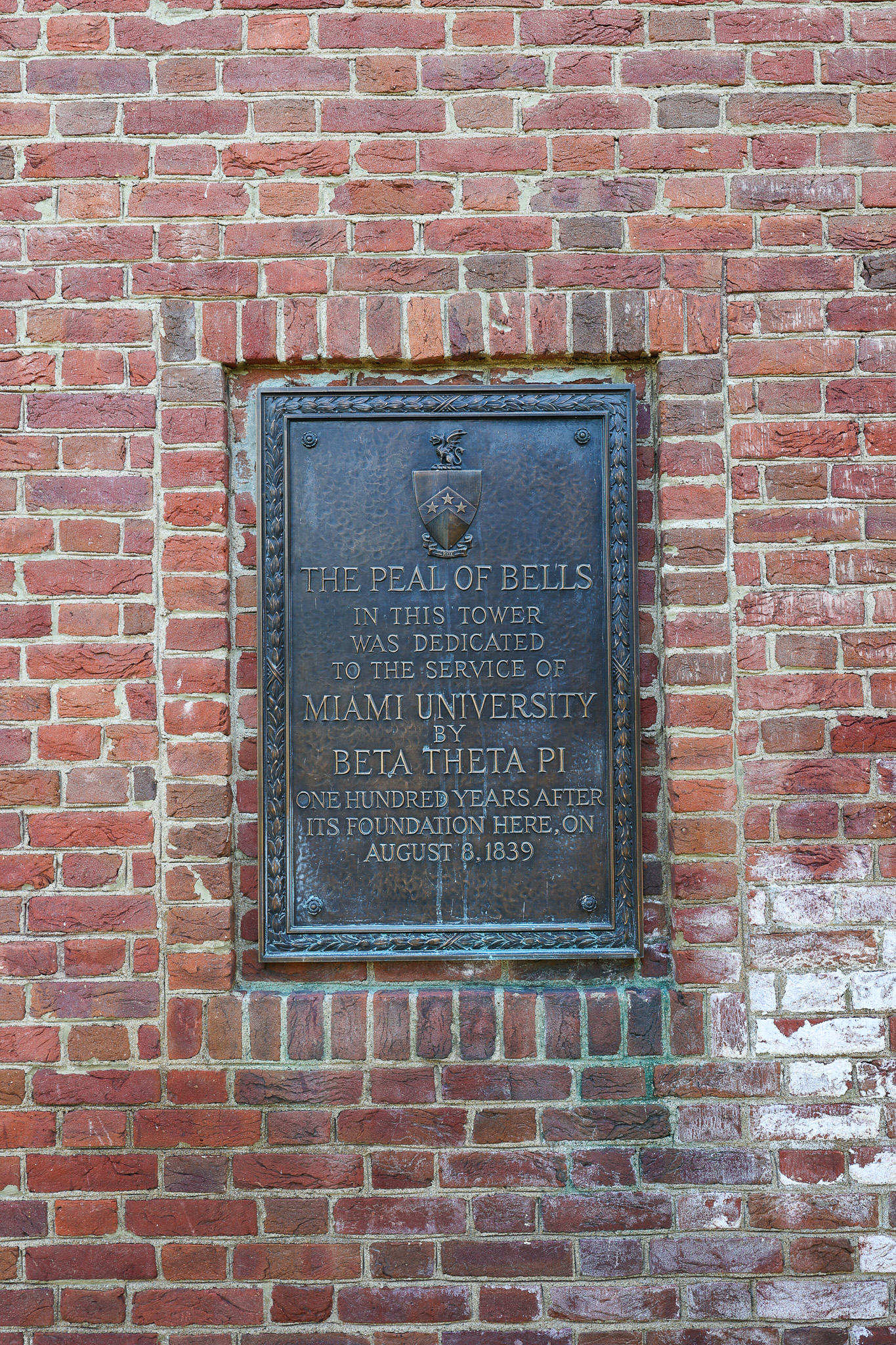
This plaque dedicates the Peal of Bells to service. It was a gift from Beta to Miami University on Centenary Day with the hope that the four bells — “Beta,” “Theta,” “Pi” and “1839-1939” — would continue to ring across campus for centuries to come.
Beta's Quasquicentennial
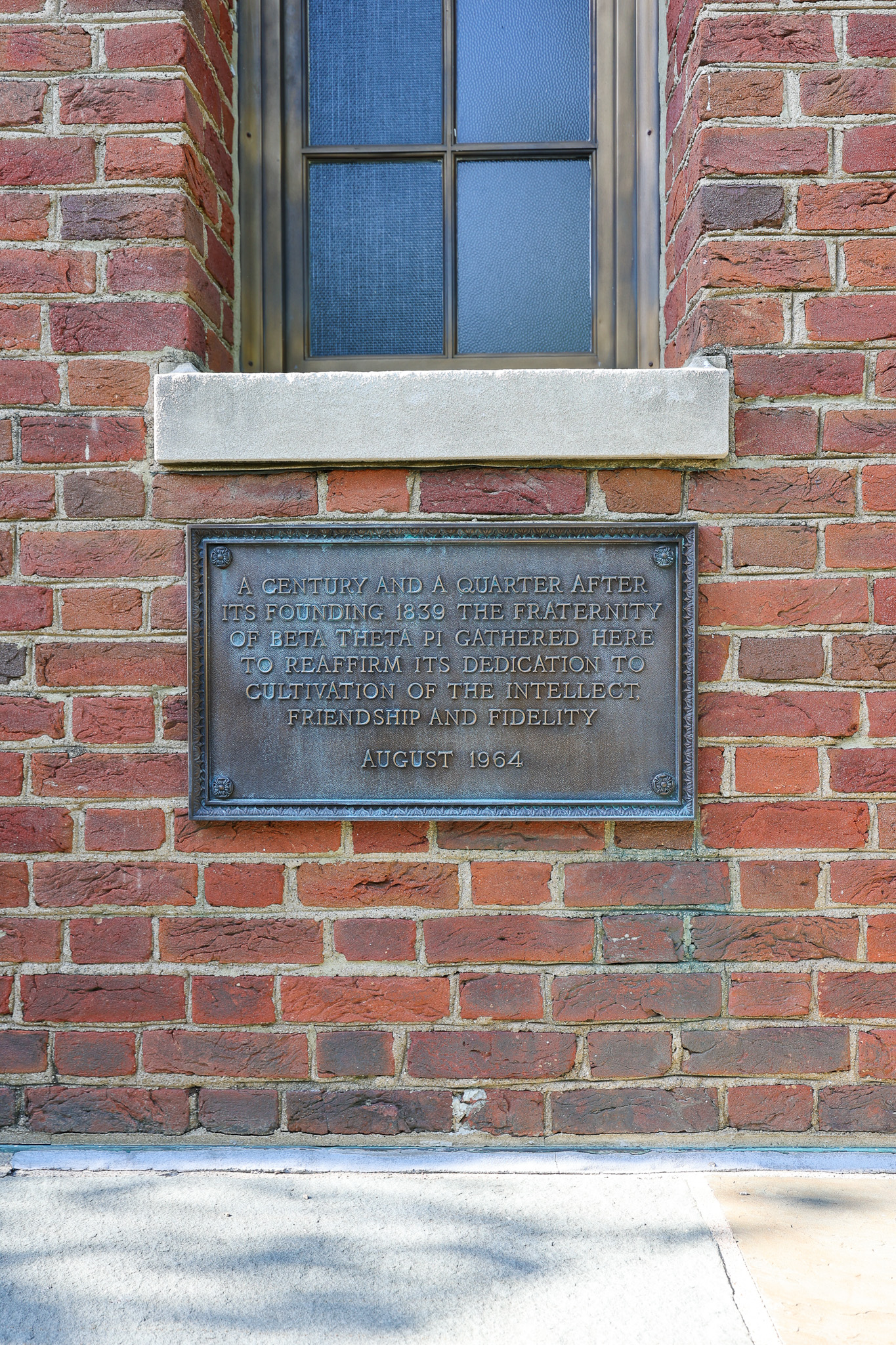
The quasquicentennial was Beta’s 125th anniversary. It was here that the great orator Dr. Seth R. Brooks, St. Lawrence 1922, gave his solemn address reaffirming Beta’s values and principles.
140 Years of Beta Theta Pi
There is no plaque to commemorate this oration at the foot of the Campanile, but travel from here with the wisdom bestowed by Beta Great Dr. Seth R. Brooks, St. Lawrence 1922.